

Bitcoin (BTC) is the first asset to reflect the Middle East conflict in its price as it is the only market still open when the US and Israel first launched an attack on Iran over the weekend of February 28. The world’s largest cryptocurrency dropped 8.5% during that session.
However, just two weeks later, Bitcoin recovered and increased in value faster than gold, the S&P 500, and Asian stock markets. Only oil and the US dollar performed better, but both are assets that directly benefit from the conflict itself.
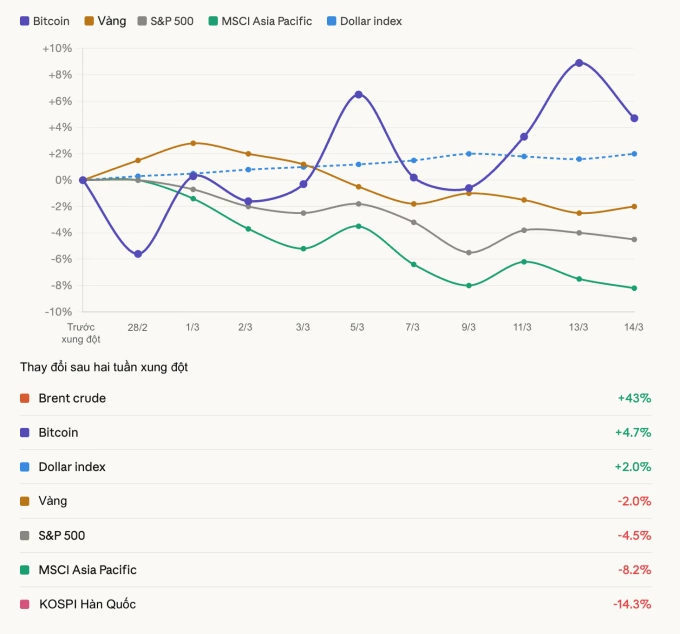
The role of Bitcoin as a “safe-haven asset” – a viewpoint that was once controversial during the sideways price movement at the end of last year – seems to be returning in investors’ minds. Additionally, BTC is acting as the “shock absorber” of the global market, with each escalation becoming larger but the declines becoming smaller.
This pattern becomes clearer when looking at where Bitcoin finds buying pressure after each sell-off. On February 28, the day of the initial airstrikes, the price hit a low near $63,000. On March 2, after Iran’s retaliatory missiles struck Gulf countries, a low of $65,300 was recorded. By March 7, a week after the prolonged conflict, the lowest point was $67,000. After the oil tanker attacks on March 12, the price held above $69,000. The most recent development is after the event on Kharg Island on March 14, where the lowest point remained above $70,300.
Simply put, each sell-off of Bitcoin finds buyers at higher levels than before. The trend line of the higher lows has increased by about $1,000-$2,000 after each event. However, the $74,000 region still acts as resistance and has rejected Bitcoin in the last 4 tests.
BTC is currently priced above $73,800 per unit, improving over 17% from the short-term low at the time of the conflict. Oil prices have risen over 40% since the conflict began. The S&P 500 has decreased. Gold has fluctuated significantly in both directions. Asian stocks had their worst week since March 2020.
However, this does not mean that Bitcoin has suddenly become a safe-haven asset, as it still declines whenever there is significant news. But it recovers faster, and each recovery maintains a higher level than before.
The contrast with earlier this year is quite stark. At the beginning of February, a sudden wave of liquidations wiped out $2.5 billion in leveraged positions over the weekend as Bitcoin plummeted to $77,000, erasing about $800 billion in market value compared to the peak in October 2025. At that time, many analysts believed it was a shock that could undermine market confidence for months to come.
However, according to Shaurya Malwa – co-leader of the data and token group in Asia at CoinDesk, it was not a systemic risk but merely a “purge” that helped eliminate the weakest investors and left a leaner market capable of absorbing bad news.
The largest buyers of cryptocurrencies come from the US, as demand from institutions is gradually returning. Bitcoin spot ETFs have recorded about $1.3 billion in net inflows from the beginning of March to the end of last week, bringing them closer to the first month of positive net inflows since October 2025.
The macro context also helps reinforce Bitcoin’s position. Last weekend, US President Donald Trump stated that he did not attack the oil infrastructure on Kharg Island – Iran’s oil-producing area – for “humanitarian reasons,” but would “immediately reconsider” if the country continued to block the Strait of Hormuz. Iran responded that any attack on energy infrastructure would trigger retaliatory attacks on US-related facilities.
The aforementioned threat, if it occurs, would significantly worsen the oil supply disruption. Previously, the International Energy Agency (IEA) had noted that the global oil supply is experiencing the largest disruption in history.
However, analysts still do not believe that Bitcoin has completely escaped risk. Market sentiment remains extremely cautious. The fear and greed index of the cryptocurrency market is still in the “extreme fear” zone. Meanwhile, the funding rate of perpetual futures contracts remains negative.
The funding rate is a periodic payment exchanged between traders in the perpetual futures market to keep contract prices close to the spot market. When the funding rate is negative, short sellers have to pay long positions. This indicates that pessimistic sentiment is prevailing and traders are willing to pay a fee to maintain their bearish bets.
Despite the many risks, the way Bitcoin “adapts” to the conflict gives investors further insight into the nature of the cryptocurrency market. It is neither a safe haven nor entirely a risky asset. BTC has become a 24/7 trading “liquidity pool” capable of absorbing shocks quickly, simply because it is the only asset still trading when events occur.