

Overview
Character: David Bressler, a data analyst with 11 years of experience, living in Florida, USA.
Implementation Timeline: Started July 2022 (idea and MVP), launched August 2022, reached $40,000 MRR around August 2023 (after ~1 year).
Country of Implementation: USA, operating internationally through SaaS platform, targeting 750 million Excel users globally.
Revenue Model
Primary Revenue Stream: SaaS (Software as a Service) with subscription-based model.
How AI-Generated Revenue: ExcelFormulaBot (now FormulaBot) uses AI to convert natural language into Excel and Google Sheets formulas in seconds (example: “Calculate average of column A” → =AVERAGE(A:A)).
Freemium Model:
- Free: 5 formulas/month, sufficient for 97% of regular users
- Paid: $6.99/month for unlimited formulas, targeting 3% heavy users in finance, accounting, marketing fields
Revenue:
- November 2022: $3,500 MRR with 50,000 users registered in first month
- December 2022: $4,200 MRR, total revenue $30,000 in 3 months
- August 2023: $40,000 MRR (~$480,000 ARR)
Additional Revenue: Affiliate sales of Excel-related products (~5% of revenue)
Costs:
- Initial: $25/month (Bubble.io), $10 (domain), and OpenAI API costs (~$4,999 after going viral)
- Current: Low costs (API, hosting, email), high profit due to no team needed
AI Tools and Technology Used
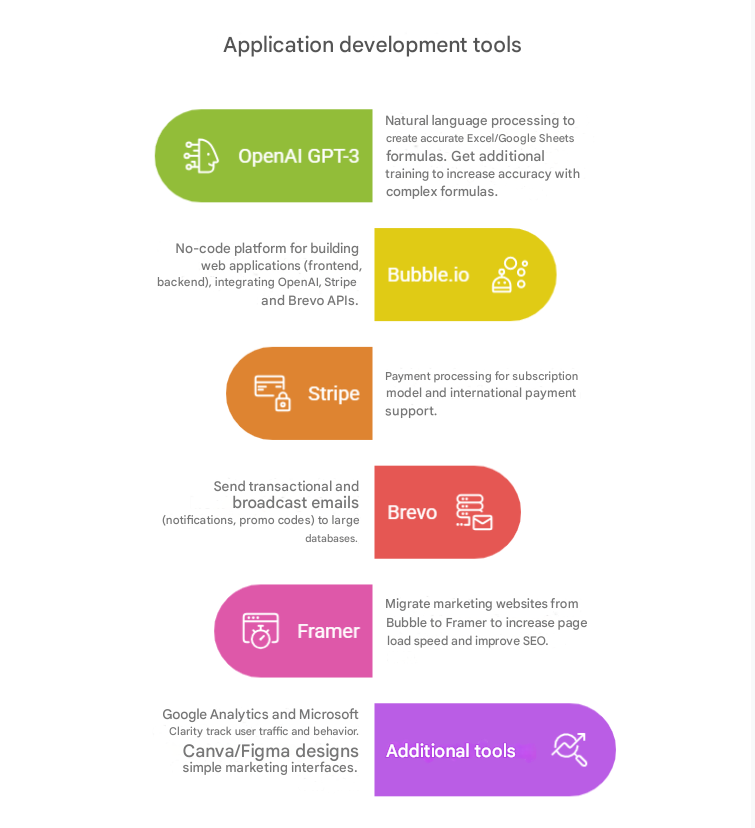
OpenAI GPT-3:
Role: Natural language processing to create accurate Excel/Google Sheets formulas. Additional training to increase accuracy with complex formulas.
Advantages: Easy integration via API, handles requests from simple to complex well
Limitations: High API costs with large traffic, risk of third-party dependency (OpenAI)
Bubble.io:
Role: No-code platform to build web application (frontend, backend), integrate OpenAI API, Stripe, and Brevo
Advantages: Easy to learn (via YouTube), no coding required, logic-building similar to Excel
Limitations: Initially slow website speed, needed switch to Framer for SEO improvement
Stripe:
Role: Payment processing for subscription model
Advantages: Easy integration via Bubble, supports international payments
Brevo:
Role: Send transactional and broadcast emails (notifications, promo codes)
Advantages: Cheaper than Mailchimp for large databases (~100,000 customers)
Framer:
Role: Moved marketing website from Bubble to Framer to increase loading speed, improve SEO
Advantages: Fast, optimized for SEO, improves user experience
Additional Tools:
- Google Analytics and Microsoft Clarity: Track traffic and user behavior (heat mapping)
- Canva/Figma: Simple interface design for marketing
Implementation Process
Phase 1: Idea and MVP (July 2022, 3 weeks):
- During paternity leave, David explored AI through GPT-3, recognized potential for creating Excel formulas from natural language
- Learned Bubble.io via YouTube and OpenAI API documentation, built MVP (simple interface with input/output formula boxes) in 3 weeks
- Initial cost: $25 (Bubble), $10 (domain)
Phase 2: Free Launch and Viral Growth (August 2022):
- Posted on Excel subreddit for feedback, received 10,000 upvotes, attracted 50,000 users in 1 month
- No login required, led to $4,999 OpenAI API costs due to large traffic
- Forced to switch to paid model
Phase 3: Subscription Model Transition (September–November 2022):
- Launched subscription website with Stripe, integrated freemium model (5 free formulas/month, $6.99/month unlimited). Had 82 customers on first day
- Sent email to 50,000 beta users with promo code, reached $3,500 MRR
- Launched on Product Hunt, achieved $2,400 revenue in 24 hours
- Went viral on TikTok through influencer with 4.5 million followers, attracted thousands of new users
Phase 4: Growth and Optimization (2023):
- Moved marketing website to Framer to improve speed and SEO. Optimized on-page (title tags, meta descriptions) and created Excel tutorial content (e.g., “How to use SUMIFS”)
- Ran Google Ads, prioritized Quality Score to optimize costs and target people searching for Excel formulas
- Refined product, added Google Sheets add-on, reached $40,000 MRR in August 2023
- Future plans: Partner with Excel influencers, add educational content, and target B2B market
Results Achieved
Revenue:
- November 2022: $3,500 MRR
- December 2022: $4,200 MRR, total $30,000 in 3 months
- August 2023: $40,000 MRR (~$480,000 ARR)
- 2024: Some sources estimate $220,000 MRR, but lacking verification evidence, possibly exaggerated
Users:
- 50,000 registrations in first month (August 2022)
- 2023: 750,000 users, with ~3% conversion to paid
Other Achievements:
- Solo startup, no team needed, low operating costs (~$5,000/month for API, hosting, email)
- Viral on Reddit, Product Hunt, TikTok, and Twitter, proving power of community marketing
- Featured in Morning Brew newsletter and Prof G podcast, increased brand recognition
- Successfully competed with 9 other Excel AI websites through effective marketing and freemium model
Key Lessons Learned
Main Success Factors:
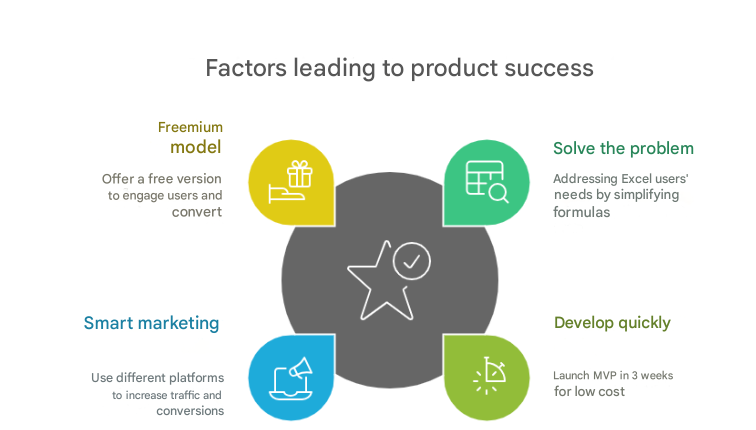
Solved Specific Problem: Met needs of 750 million Excel users by simplifying formula creation
Fast No-Code: Used Bubble.io to launch MVP in 3 weeks with $35 cost
Smart Marketing:
- Reddit (10,000 upvotes) and Product Hunt ($2,400 in 24 hours) brought free traffic
- TikTok viral through influencer with 4.5 million followers
- Google Ads and SEO (tutorial content, site speed) for sustainable growth
Freemium Model: Free 5 formulas/month attracted users, 3% conversion to paid generated large revenue
Creative Differentiators:
- Integrated GPT-3 into super-specific niche (Excel/Google Sheets), created easy-to-use, accurate product
- “Social listening” marketing: Responded to every comment/DM on Reddit, Twitter, ensuring community engagement
- Leveraged organic influencers (TikTok, Twitter) without large advertising costs
Challenges and Solutions:
High API Costs ($4,999): Switched to paid model, added login to control traffic
Lack of Coding Skills: Learned Bubble via YouTube, leveraged rich documentation
Competition: 9 similar websites launched at same time. Overcame through memorable brand (ExcelFormulaBot), freemium model, and active marketing
Limited Time: Worked nights after full-time job, focused on important tasks
Tips for Beginners
Find Specific Niche: Identify problems in daily work (Excel, Word, email) and use AI to solve them
Use No-Code: Start with Bubble ($25/month) or Webflow, learn via YouTube (~1–2 weeks)
Fast MVP: Build simple product (1 page, input/output boxes) in 1–2 weeks
Free Marketing:
- Post on Reddit (relevant subreddits), Product Hunt, or TikTok for feedback and traffic
- Join communities (Reddit, Twitter), respond to every comment/DM to build credibility
Freemium: Provide limited free features to attract, then charge heavy users
Free Tools: Use ChatGPT (free) to test ideas, Canva for design, Google Analytics for tracking
Source / Links
Original Link: upstackstudio.com – Micro SaaS Examples
Social Media/Website: Twitter – @bresslertweets